
Quick Summary: Seoul Subway & T-Money Essentials
- Card Cost: ₩3,000 to ₩5,000 (~$2.25 to ~$3.75 USD) for a basic blank T-money card
- Base Transit Fare: ₩1,400 (~$1.05 USD) per trip (up to 10 km) with a T-money card
- System Operating Hours: 05:30 AM – 24:00 (Midnight, last trains depart between 23:30 and 23:50)
- Best Time to Ride: 10:00 AM – 16:30 PM & after 20:00 PM (Avoid rush hours: 07:30–09:00 AM and 18:00–19:30 PM)
- System Difficulty: Easy to Moderate (Fully bilingual in English, color-coded, and numbered)
After navigating Seoul’s extensive urban landscape for over a decade, this guide at Searching Korea can confidently say that the Seoul Metropolitan Subway is one of the world’s most efficient, clean, and safe public transportation systems. Spanning 23 lines and over 600 stations across Seoul, Incheon, and Gyeonggi-do province, it carries over 7 million passengers daily. However, for a first-time visitor, the maze of colors, lines, and underground exits can feel overwhelming.
In this comprehensive guide, we will break down everything you need to know about navigating the Seoul subway system, utilizing the essential T-money transit card, saving money with newer pass options like the Climate Card, and avoiding common tourist mistakes based on our years of living on the ground in Seoul.
What is a T-Money Card and Why Do You Need It?
The T-money card is a rechargeable contactless smart card used to pay for public transit across South Korea, including subways, city buses, taxis, and even regional buses. Beyond transit, you can use your T-money card to purchase items at convenience stores (CU, GS25, 7-Eleven, Emart24), bakeries, vending machines, and lockers.
While you can buy single-use tickets at subway station vending machines, we strongly advise against it. Single-use paper/plastic tickets require a ₩500 (~$0.37 USD) cash deposit that you must manually redeem at a deposit refund machine at your destination station every single time. Furthermore, single-use tickets do not give you access to free transit transfers between subways and buses.
| Feature | T-Money Transit Card | Single-Use Ticket |
|---|---|---|
Where to Buy and How to Load Your T-Money Card
1. Purchasing Your Card
the easiest place to purchase a T-money card is immediately upon arrival at Incheon International Airport (ICN) or Gimpo International Airport (GMP). You can buy them at any convenience store inside the terminal:
- CU, GS25, or 7-Eleven Convenience Stores: Located in both Arrival Halls (T1 and T2). Card purchase prices range from ₩3,000 (~$2.25 USD) for a basic card up to ₩5,000 (~$3.75 USD) for character cards (Kakaofriends, Line Friends, or Sanrio).
- Subway Station Vending Machines: Card vending machines located inside subway stations sell standard T-money cards for ₩3,000 to ₩4,000.
2. Loading (Recharging) Cash onto Your Card
CRUCIAL RULE: You must reload standard T-money cards using CRISP SOUTH KOREAN WON (CASH ONLY). Automated subway ticket machines and convenience stores do not accept foreign credit cards or mobile payment apps (Apple Pay/Google Pay) to reload standard T-money balance.
How to load at a subway station machine:
- Approach the automated ticketing/recharging machine (Select “English” on the touch screen).
- Place your T-money card onto the designated sensor pad (usually outlined in blue or red).
- Select your desired reload amount: ₩1,000, ₩3,000, ₩5,000, ₩10,000, ₩20,000, ₩30,000, or ₩50,000.
- Insert Korean Won cash notes into the bill slot.
- Wait 3–5 seconds until the screen confirms the load, then collect your card.
You can also reload at any convenience store counter by handing your card and cash to the cashier and stating the amount (e.g., “Man-won reload, please” for ₩10,000 / ~$7.50 USD).
Understanding Fares, Transfer Rules, and Alternative Passes
Standard Distance-Based Fare Structure (2025 Rates)
The Seoul subway operates on a distance-based fare scale:
- Base Fare (0 to 10 km): ₩1,400 (~$1.05 USD)
- 10 km to 50 km: Additional ₩100 (~$0.08 USD) charged for every 5 km traveled
- Over 50 km: Additional ₩100 (~$0.08 USD) charged for every 8 km traveled
- Early Bird Discount: Passengers who tap in before 06:30 AM receive a 20% discount off the base fare (₩1,120 / ~$0.84 USD).
The Essential Transfer Rule (Save Money!)
When using a T-money card, transfers between subway lines, city buses, and neighborhood shuttle buses (Maeul buses) are FREE for up to 4 transfers within a single journey. To qualify:
- You must tap your T-money card on the reader when EXITING the subway station or bus.
- You must tap into your next line or bus within 30 minutes (extended to 60 minutes between 21:00 PM and 07:00 AM).
- If you fail to tap out when exiting, you will be charged maximum distance penalties on your next trip and lose transfer privileges.
2025 Alternative Transit Card Options
1. Climate Card (Short-Term Tourist Pass): Released by the Seoul Metropolitan Government, this targeted pass gives unlimited rides on Seoul subways, Seoul city buses, and the Ddareungi public bike system.
- 1-Day Pass: ₩5,000 (~$3.75 USD)
- 2-Day Pass: ₩8,000 (~$6.00 USD)
- 3-Day Pass: ₩10,000 (~$7.50 USD)
- 5-Day Pass: ₩15,000 (~$11.25 USD)
- 7-Day Pass: ₩20,000 (~$15.00 USD)
Note: The Climate Card only covers subway lines within Seoul city limits. It does not cover the Shinbundang Line, non-Seoul suburban stretches, or the airport portion of the AREX line beyond Gimpo Airport. Physical cards cost ₩3,000 and can be bought at Tourist Information Centers or convenience stores near major stations.
2. WOWPASS & NAMANE Cards: These are combined prepaid debit cards with built-in T-money functionality. You can load foreign currencies directly onto the card via dedicated kiosks at major subway stations, converting them to KRW for retail card spending while keeping a separate T-money chip on the card (which still must be loaded with KRW cash at subway kiosks).
Navigating the Seoul Subway System: Step-by-Step
1. Essential Navigation Apps (Avoid Google Maps!)
this guide cannot emphasize this enough: Do not rely on Google Maps in South Korea. Due to national security map-data restrictions, Google Maps does not provide accurate walking routes or real-time public transit schedules in Korea.
Instead, download these essential bilingual apps prior to your departure:
- Naver Map (Recommended): The gold standard for navigation in Korea. Provides turn-by-turn walking routes, real-time subway train arrivals, designated train car recommendations for fast transfers, and exact exit numbers.
- KakaoMap: Excellent alternative with highly reliable subway schedules and live bus tracking.
- Subway Kakao: A dedicated subway map app showing optimal routes, transit transfer times, and door numbers for fast transfers.
2. Decoding Subway Stations and Line Colors
Seoul’s subway system uses color coding, line numbers, and station numbering. Every line has a designated color:
- Line 1 (Dark Blue): Connects Seoul Station, Jongno, and travels out to Incheon and Suwon.
- Line 2 (Green): The major loop line connecting Hongdae, Gangnam, Euljiro, and Myeongdong (via Euljiro 1-ga).
- Line 3 (Orange): Connects Gyeongbokgung Palace, Anguk (Insadong), Express Bus Terminal, and Sinsa.
- Line 4 (Light Blue): Connects Dongdaemun, Myeongdong, and Seoul Station.
- Line 5 (Purple): Connects Gimpo Airport, Yeouido, and Gwanghwamun.
- Line 6 (Brown): Connects Itaewon, World Cup Stadium, and Mangwon.
- Line 7 (Olive): Connects Express Bus Terminal and Gangnam area.
- Line 8 (Pink): Connects Jamsil and Seongnam.
- Line 9 (Gold): Connects Gimpo Airport, Yeouido, and Gangnam (Features Local vs. Express trains).
- AREX (Sky Blue): Airport Railroad Express connecting Incheon T1/T2, Gimpo Airport, and Seoul Station.
Every station has a 3-digit number (e.g., Station 239 is Hongik University on Line 2). The first digit indicates the line number (Line 2 = 2xx), making it easy to confirm you are traveling in the right direction even if you cannot read Korean characters.
3. Directional Signs: Look for the Destination & Next Station
When walking down to the platform, overhead signs will display the line color, the terminal destination (the final stop in that direction), and the immediate next station. Always check the arrow pointing toward the next station to verify you are on the correct side of the platform!
Major Subway Hubs & Key Stations for Tourists
Here are exact details for the major transport hubs and tourist destinations in Seoul:
1. Incheon International Airport Station (Terminal 1 & Terminal 2)
- Lines Served: AREX (Airport Railroad Express)
- Address: 272 Gonghang-ro, Jung-gu, Incheon
- Key Details: Offers two train types to Seoul Station:
- Express Train: Non-stop to Seoul Station (43 mins from T1 / 51 mins from T2). Price: ₩11,000 (~$8.25 USD). Reserved seating. Requires a separate ticket.
- All-Stop Train: Stops at 14 stations including Hongdae (59 mins from T1). Price: ₩4,150 (~$3.10 USD). Standard subway seating. T-money card accepted!
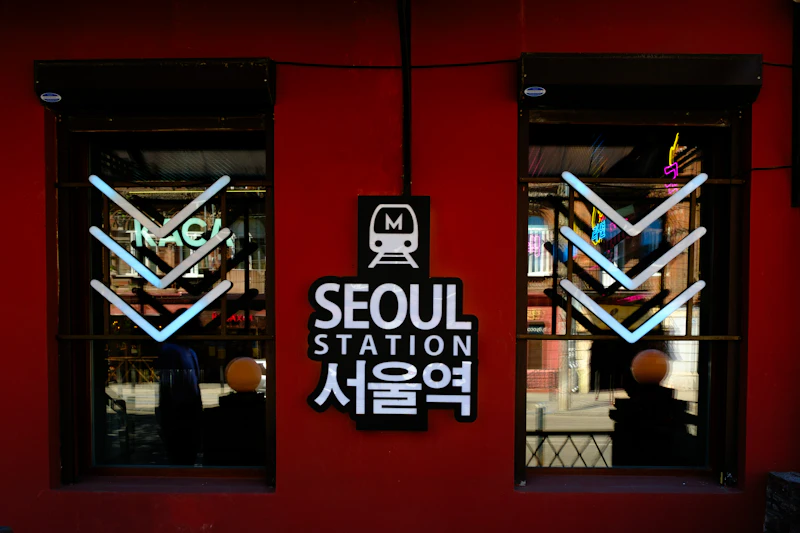
2. Seoul Station (Central Hub)
- Lines Served: Line 1, Line 4, AREX, Gyeongui-Jungang Line, KTX High-Speed Rail
- Address: 405 Hangang-daero, Yongsan-gu, Seoul
- Operating Hours: 05:15 AM – 00:15 AM
- Tourist Exits: Exit 1 (Lotte Mart & Seoul Station Plaza), Exit 15 (AREX Airport Express Transfer Terminal).
3. Hongik University Station (Hongdae)
- Lines Served: Line 2 (Station #239), AREX, Gyeongui-Jungang Line
- Address: 160 Yanghwa-ro, Mapo-gu, Seoul
- Operating Hours: 05:30 AM – 00:00 AM
- Tourist Exits: Exit 9 (Main Hongdae Shopping & Nightlife Street), Exit 3 (Yeonnam-dong / Gyeongui Line Forest Park).
4. Myeongdong Station
- Lines Served: Line 4 (Station #424)
- Address: 126 Toegye-ro, Jung-gu, Seoul
- Operating Hours: 05:30 AM – 23:55 PM
- Tourist Exits: Exit 6 (Direct access to Myeongdong Walking Street & Night Market), Exit 3 (Namsan Cable Car walking path).
5. Anguk Station (Bukchon Hanok Village & Insadong)
- Lines Served: Line 3 (Station #328)
- Address: 102 Yulgok-ro, Jongno-gu, Seoul
- Operating Hours: 05:35 AM – 23:50 PM
- Tourist Exits: Exit 2 & 3 (Bukchon Hanok Village & Onion Cafe), Exit 6 (Insadong Cultural Street).
6. Gangnam Station
- Lines Served: Line 2 (Station #222), Sinbundang Line
- Address: 396 Gangnam-daero, Gangnam-gu, Seoul
- Operating Hours: 05:30 AM – 00:20 AM
- Tourist Exits: Exits 10 & 11 (Gangnam Commercial District & Underground Shopping Mall).
Budget Breakdown for Transport in Seoul
To help you budget accurately for your trip, here is a practical estimation of transport costs across different travel styles for a 5-day stay in Seoul:
| Traveler Profile | Transit Mode | Estimated Daily Cost | 5-Day Total Estimate |
|---|---|---|---|
Best Time to Visit & Ride the Subway
Understanding when to ride the subway can make the difference between a relaxing journey and being packed into a train car like sardines.
Peak Rush Hours to Avoid
- Morning Rush: 07:30 AM to 09:00 AM (Weekdays). Avoid Line 2, Line 9 Express, and Line 7 during these hours at all costs.
- Evening Rush: 18:00 PM to 19:30 PM (Weekdays). Station platforms at Gangnam, Seoul Station, and Yeouido become extremely congested.
Optimal Times to Ride
the best window for stress-free sight-seeing travel is between 10:00 AM and 16:30 PM, or late in the evening after 20:00 PM. During these hours, you are almost guaranteed to find open seats on most subway lines.
Seasonal Transit Considerations
- Spring (April–May) & Autumn (September–November): Ideal times to visit Seoul. Weather is moderate, making walking between underground station exits and destinations pleasant.
- Summer Monsoon (July–August): Heavy downpours are common. Seoul’s underground passages and linked underground shopping centers (such as Gangnam, Express Bus Terminal, and COEX) provide completely climate-controlled transit options across whole city blocks.
- Winter (December–February): Subway station platform benches are heated! Look for seats with red signs indicating thermal heating during cold winter months.
Expert Tips (Insider Knowledge from 10+ Years in Seoul)
1. The “15-Minute Re-entry” Restroom Emergency Rule
Accidentally tapped through the wrong subway turnstile? Or do you urgently need to use the station restroom located outside the ticket barriers? If you tap back out and tap back into the same station on the same line within 15 minutes using your T-money card, you will not be charged an extra base fare. This free re-entry rule was officially implemented by the Seoul Metropolitan Government to save commuters from accidental double charges!
2. The Line 9 Express vs. Local Trap
Line 9 (Gold Line) runs two different types of trains on the exact same track: Local Trains (stop at every station) and Express Trains (skip small stations, stopping only at major hubs like Gimpo Airport, Dangsan, Yeouido, Express Bus Terminal, and Bongeunsa). Express train cars have yellow LED screens on the sides and are notoriously crowded during peak hours. If your destination is a minor station, make sure you step onto a Local train, or transfer to a Local train at an express transfer station.
3. Storing Luggage at Stations (T-Luggage)
Do not drag heavy suitcases across the city! Most Seoul subway stations feature automated lockers called T-Luggage or Safe Storage.
- Small lockers cost ₩2,000 to ₩3,000 (~$1.50–$2.25 USD) for 4 hours.
- Large suitcase lockers cost ₩8,000 to ₩12,000 (~$6.00–$9.00 USD) per day.
- Payment can be made using your credit card or T-money card via the touchscreen interface (available in English).
4. Designated Quiet and Air-Conditioned Cars
During summer months, Seoul subway trains run dedicated Weak AC Cars (약냉방차) for passengers sensitive to cold air. These are usually located at cars #3 and #4 on Lines 1, 3, and 4, and cars #4 and #5 on Lines 5, 6, and 7. Conversely, during winter, these cars offer milder heat.
Common Mistakes to Avoid
- Sitting in Priority Seats: At both ends of every subway car, there are designated seats (usually marked with pink, light blue, or yellow badges) for the elderly, disabled, and pregnant women. Even if the subway car is completely empty, locals do NOT sit in these seats unless they belong to those categories. Keep these clear to remain polite and respectful.
- Trying to Reload T-Money with a Foreign Credit Card: Automated subway reloading kiosks and convenience store terminals ONLY take South Korean cash (Won) for T-money reloads. Always carry crisp ₩5,000 or ₩10,000 notes with you for transit top-ups.
- Tapping Out at the Wrong Transfer Gate: At complex interchange stations (e.g., Seoul Station or Express Bus Terminal), you may see transfer turnstiles when switching between lines. Always tap your card on these internal transfer gates—you will be charged ₩0 extra, but it tracks your route accurately so you receive free transfer benefits.
- Assuming All Platform Doors Open on the Same Side: Subway train doors alternate between opening on the left or right side depending on the station layout. Check the overhead screens inside the train car or listen to the English audio announcements (“The doors are on your left”) before preparing to exit.
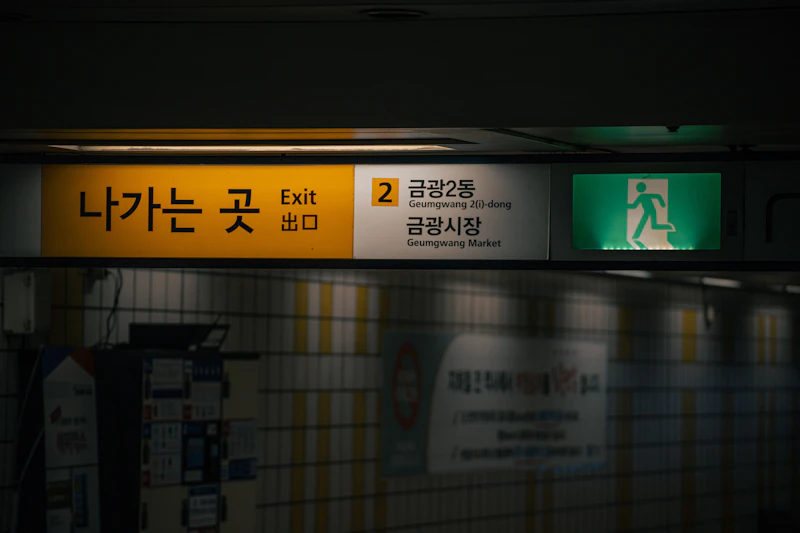
- Ignoring Exit Numbers: Seoul subway stations are massive underground complexes. For instance, Jongno 3-ga Station has 16 exits spanning across three lines! If you take the wrong exit, you could end up several blocks away from your destination. Always double-check your destination exit number on Naver Map before walking up to the street level.
Frequently Asked Questions (FAQ)
Can I use one T-money card for multiple people?
While convenience store cashiers can technically configure a single T-money card for multiple passengers on city buses, it does NOT work for the subway. Every individual traveler must have their own separate T-money card to tap in and out of subway turnstiles. (Children under 6 ride free).
What happens to unused money on my T-money card at the end of my trip?
You can get a cash refund for unused balances up to ₩20,000 (~$15.00 USD) at any convenience store (CU, GS25, 7-Eleven) for a minor service fee of ₩500 (~$0.37 USD). For balances between ₩20,000 and ₩50,000, refunds can be processed at subway station customer service centers. The purchase cost of the card itself (₩3,000–₩5,000) is non-refundable.
Is the subway safe to ride late at night?
Yes, the Seoul subway system is exceptionally safe. Stations and train cars are equipped with high-definition CCTV cameras, emergency call buttons, and active subway police patrols. Violent crime is extremely rare. However, be mindful that the last trains depart between 23:30 and 23:50 PM on weekdays, so plan your night out in nightlife districts like Hongdae or Itaewon accordingly.
Editorial Note: This guide was researched, written, and updated by the Searching Korea editorial team based on over a decade of daily, first-hand experience riding public transit in Seoul. We regularly re-verify current transit tariffs, policy changes, and equipment updates directly with the Seoul Metropolitan Rapid Transit Corporation to ensure international travelers receive the most accurate on-the-ground travel guidance possible.