
Quick Summary
- Park Admission: Free (₩0 / $0 USD)
- Best Time to Visit: Late October to Mid-November (Peak Ginkgo: Oct 28 – Nov 10)
- Recommended Duration: 3 to 5 hours (including park walking trail and nearby Seongsu cafe tour)
- Trail Difficulty: Easy (Flat, paved/dirt footpaths; wheel-chair and stroller accessible)
- Primary Highlights: Ginkgo Tree Forest Tunnel, Mirror Pond, Metasequoia Lane, Eco-Forest Deer Park, Seongsu-dong Atelier Street
Introduction: Why Seoul Forest is Central Seoul’s Autumn Masterpiece
Having spent over a decade wandering the streets and green spaces of Seoul, our editorial team has tracked the subtle turn of seasons across every corner of this metropolis. While Namsan Mountain offers sweeping panoramas and the royal palaces provide classic architectural backdrops, Seoul Forest (서울숲) remains our absolute favorite urban haven when autumn reaches its crescendo in South Korea. Located along the northern banks of the Han River in Seongdong-gu, Seoul Forest spans over 1.16 million square meters of reclaimed land, once used as a royal hunting ground, a waterworks facility, and a horse racetrack.
Today, Seoul Forest functions as Seoul’s equivalent to New York’s Central Park or London’s Hyde Park. When autumn arrives—typically spanning from late October through mid-November—the park undergoes a breathtaking transformation. Thousands of ginkgo trees turn an incandescent, buttery yellow, while towering metasequoias shift into deep rust red, and Japanese maples flare in brilliant crimson. Coupled with its immediate adjacency to Seongsu-dong—Seoul’s vibrant, design-forward neighborhood often dubbed the “Brooklyn of Seoul”—a visit to Seoul Forest offers the single best autumn foliage day-trip within the city limits.
In this definitive guide, this guide at Searching Korea distills years of on-the-ground experience to provide you with an exact walking route, prime photography locations, insider tips, budget breakdowns, and curated nearby cafe recommendations to ensure an unforgettable autumn walk.
Essential Logistics: Getting There, Hours & Location Details
Navigating to Seoul Forest is exceptionally straightforward, thanks to Seoul’s world-class public transit network. We strongly advise taking the subway, as parking lots around Seongsu-dong experience heavy congestion during autumn weekends.
Subway Access
- Primary Route (Closest): Seoul Forest Station (서울숲역) on the Suin-Bundang Line. Take Exit 3 or Exit 4. Walk straight for approximately 2 to 3 minutes, and you will arrive directly at Park Entrance 1 and the Understand Avenue container complex.
- Secondary Route: Ttukseom Station (뚝섬역) on Subway Line 2. Take Exit 8. Walk straight south along Seoul숲길 (Seoul-forest-gil) for approximately 8 to 10 minutes (about 650 meters). This route walks you through the heart of the Seongsu cafe district before entering the park.
Exact Park Address
Korean Address: 서울특별시 성동구 뚝섬로 273 (성수동1가)
English Address: 273 Ttukseom-ro, Seongdong-gu, Seoul
Operating Hours & Seasonal Closures
- Main Park Grounds: Open 24 hours a day, 365 days a year.
- Eco-Forest (Deer Enclosure & Skybridge Area): Open daily from 05:30 AM to 09:30 PM.
- Insect Botanical Garden & Butterfly Conservatory: Open 10:00 AM to 05:00 PM (Last entry at 04:30 PM). Closed every Monday.
- Visitor Center / Information Desk: Open 10:00 AM to 06:00 PM daily.
The Ultimate Seoul Forest Autumn Foliage Walking Route
Seoul Forest is vast, divided into five major thematic zones: Cultural Art Park, Eco-Forest, Experiential Learning Park, Marsh Plants Center, and the Hangang River Waterfront Park. To catch the absolute best autumn foliage without wasting steps, Consider following this 2.5-kilometer optimized loop trajectory.
Stage 1: Entrance 1 to the Mirror Pond (거울연못)
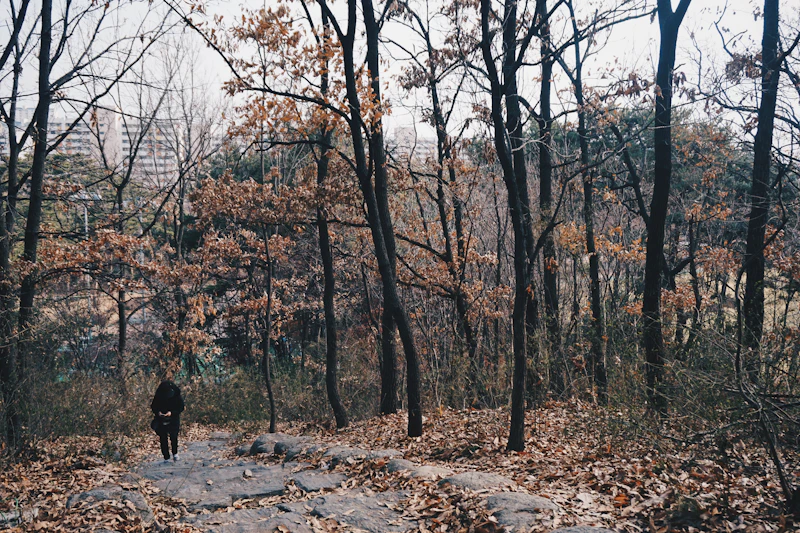
Start your walk from Seoul Forest Station Exit 3. Enter through Gate 1, past the iconic sculptures of galloping racehorses—a nod to the park’s history as the Ttukseom Racetrack. Walk east toward the Mirror Pond (거울연못). This linear, shallow pool of crystal-clear water acts as a natural mirror, reflecting the fiery orange metasequoia trees and golden ginkgos lined along its edge. On a still autumn morning, the reflection creates a stunning, surreal visual contrast that ranks among our favorite photo locations in Seoul.
Stage 2: The World-Famous Ginkgo Tree Forest (은행나무숲)
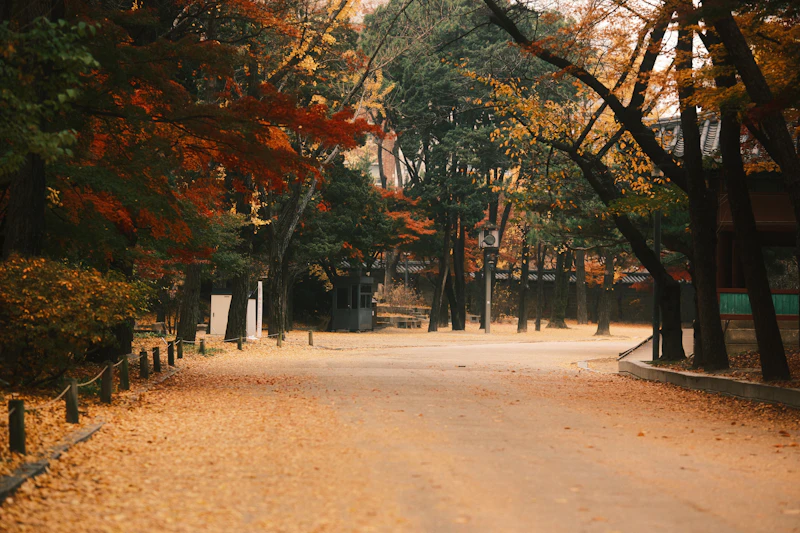
From the Mirror Pond, head northeast toward the central lawn and navigate toward the dedicated Ginkgo Tree Forest (은행나무숲) located near the park’s eastern quadrant (near Gate 9/10). Here, hundreds of tall ginkgo trees are planted in high-density grid formations. As the foliage peaks, the canopy creates a solid ceiling of vibrant gold, while falling leaves carpet the earth in a thick yellow blanket. Walking through this natural golden hallway provides a sensory experience unlike any other in the capital.
Stage 3: Metasequoia Road & The Eco-Forest Skybridge
After immersing yourself in yellow, stroll north across the small footbridges toward the Metasequoia Road and the Eco-Forest (생태숲) enclosure. The metasequoia trees turn later than the ginkgos, shifting into rich amber, terracotta, and dark bronze tones. Ascend the elevated wooden pedestrian skybridge that spans across the Eco-Forest deer park. From this vantage point, you can look down upon free-roaming spotted deer (*Cervus nippon*) grazing among carpeted fall foliage, with the modern towers of Seongsu and the Han River visible in the distance.
Stage 4: Exit via Atelier Street to Seongsu-dong
Loop back west past the central lake and exit through Gate 4 or Gate 5. This brings you directly onto Seoul-forest-gil (Atelier Street), transitioning your morning park stroll effortlessly into an afternoon of boutique shopping and artisanal coffee tasting.
Top Photo Locations & Insider Composition Tips
To help you capture editorial-grade photographs during your autumn visit, this guide has compiled our precise camera location recommendations:
1. The Ginkgo Grid Tunnel
- Location: Deep inside the Ginkgo Tree Forest (Section 9 on park maps).
- Best Time: 07:30 AM – 09:00 AM (to avoid crowds).
- Pro Tip: Crouch down low to capture the golden leaf carpet in your foreground while shooting down one of the linear avenues of trunks. Use a telephoto lens (85mm to 135mm focal range) to compress the background trees, making the golden foliage appear significantly denser than it does to the naked eye.
2. Mirror Pond Reflections
- Location: Directly adjacent to the Park Visitor Center.
- Best Time: Early morning (for dead-still water with minimal wind distortion).
- Pro Tip: Position yourself at the eastern edge looking west. Align the towering metasequoia trees so their reflections mirror symmetrically across the water’s surface.
3. Elevated Pedestrian Deer Bridge
- Location: Eco-Forest Skybridge (Overhead walk).
- Best Time: 03:30 PM – 05:00 PM (Golden Hour).
- Pro Tip: Shoot directly into the setting sun backlighting the amber leaves of the metasequoias. Frame the grazing deer below with glowing leaves filling the top half of your frame.
Where to Warm Up: 4 Best Nearby Seongsu Cafes
No autumn walking tour in Seoul is complete without experiencing the legendary Seongsu cafe culture. Located right across the street from Seoul Forest, these four establishments offer exceptional coffee, atmospheric interiors, and top-tier autumnal treats.
1. Center Coffee (센터커피)
Center Coffee provides the absolute best park views in Seongsu. Located directly along the perimeter fence of Seoul Forest, this multi-story brick sanctuary was founded by world-recognized baristas. Sit by the second-floor window counter to sip single-origin hand drip coffee while gazing directly down into the autumn leaves of the park below.
- Address: 28-11 Seoulforest 2-gil, Seongdong-gu, Seoul (서울특별시 성동구 서울숲2길 28-11)
- Operating Hours: 10:00 AM – 09:00 PM (Closed Mondays)
- Prices: Geisha Hand Drip: ₩9,000 / ~$6.60 USD; Cafe Latte: ₩6,000 / ~$4.40 USD
2. Cafe Onion Seongsu (카페 어니언 성수)
Housed in a meticulously preserved 1970s industrial factory building, Cafe Onion is a legendary landmark in Seongsu-dong. Featuring exposed concrete walls, rusted steel beams, and a lush rooftop patio, it serves exceptional freshly baked pastries alongside high-grade espresso drinks. Try their signature *Pandoro*—a mountain-shaped Italian sweet bread dusted generously with powdered sugar that looks like snow-capped peaks.
- Address: 8 Achasan-ro 9-gil, Seongdong-gu, Seoul (서울특별시 성동구 아차산로9길 8)
- Operating Hours: Mon–Fri: 08:00 AM – 10:00 PM; Sat–Sun: 10:00 AM – 10:00 PM
- Prices: Pandoro Pastry: ₩6,000 / ~$4.40 USD; Americano: ₩5,500 / ~$4.00 USD
3. Clementine (클레멘타인)
If you prefer a warm, European-inspired floral aesthetic, Clementine is an idyllic residential home turned flower shop and cafe. The ground floor features fresh floral arrangements, while the cozy seating upstairs overlooks quiet residential lanes. Their warm pumpkin lattes and butter scones are seasonal perfection on a crisp November afternoon.
- Address: 5-1 Seoulforest 2-gil, Seongdong-gu, Seoul (서울특별시 성동구 서울숲2길 5-1)
- Operating Hours: 11:00 AM – 09:00 PM daily
- Prices: Cafe Latte: ₩6,500 / ~$4.75 USD; Seasonal Butter Scone: ₩4,800 / ~$3.50 USD
4. Cafe Grandpa Factory (할아버지공장)
A massive, artsy cultural space famous for having a literal wooden treehouse built into a large zelkova tree in its courtyard. The interior spans two expansive floors filled with wooden sculptures, industrial artwork, and cozy leather armchairs. It’s ideal for larger groups looking for comfortable seating and hearty lunch options alongside coffee.
- Address: 9 Seongsuiro 7-ga-gil, Seongdong-gu, Seoul (서울특별시 성동구 성수이로7가길 9)
- Operating Hours: 11:00 AM – 10:00 PM daily
- Prices: Cold Brew Coffee: ₩7,000 / ~$5.10 USD; Homemade Pasta: ₩21,000 / ~$15.30 USD
Best Time to Visit: Precise Seasonal Timing & Foliage Tracker
Seoul’s autumn foliage timeframe can shift slightly depending on early autumn rain and temperature dips, but historical trends over our ten years of tracking provide reliable windows:
| Foliage Stage | Typical Date Range | What to Expect |
|---|---|---|
| Early Foliage Turn | October 15 – October 24 | Trees begin transitioning. Ginkgo leaves turn light yellow-green; maples show red hints. Minimal foliage on ground. Light crowds. |
| Peak Ginkgo Foliage | October 25 – November 7 | THE PRIME WINDOW. Ginkgo tree canopy achieves 100% solid, brilliant yellow color. Leaves begin dropping, creating golden carpets. High photo opportunities. |
| Peak Metasequoia & Late Fall | November 8 – November 18 | Ginkgo leaves drop heavily forming thick ground coverage. Metasequoia trees peak in rich copper/rust tones. Cool breeze, crisp autumn air. |
| End of Foliage Season | November 19 onwards | Most tree canopies thin out. Bare branches dominate. Winter chill sets in across Seoul. |
Time of Day Recommendation: this guide strongly advises arriving at the park between 07:30 AM and 09:00 AM. By 11:00 AM, thousands of local visitors, families, and picnic-goers arrive. The early morning hour delivers clear lighting, calm winds for water reflections, and completely crowd-free photographs inside the ginkgo grid.
Expert Tips: Insider Advice You Won’t Find in Standard Guidebooks
- Rent a Public “Ttabongyi” Bike: Seoul’s official public bicycle network, *Ttabongyi* (따릉이), has major docking hubs right outside Seoul Forest Station Exit 3 and Ttukseom Station. You can rent a bike via mobile app for just ₩1,000 (~$0.75 USD) per hour to cruise along the paved perimeter trails down to the Han River intersection.
- Luggage Storage Hacks: If you are visiting directly after arriving at KIX/ICN or checking out of your hotel, do not drag suitcases across dirt trails. Use the luggage lockers located inside Seoul Forest Subway Station (Suin-Bundang Line) or the electronic lockers right next to the Visitor Center inside Gate 1. Prices range from ₩2,000 to ₩5,000 (~$1.50 to ~$3.65 USD) for 4 hours depending on locker size.
- Deer Feeding Station Details: You can purchase small cups of deer feed from automated vending machines near the Eco-Forest entrance for ₩1,000 (~$0.75 USD) cash (exact ₩1,000 notes required). It is an delightful activity if traveling with children. Note that feed machines sell out quickly on sunny weekends.
- Picnic Basket Rentals: Nearby cafes like *Local Stitch* and specialized picnic rental shops along Atelier Street offer picnic sets (mat, wooden basket, thermos, cups, and small snacks) for around ₩20,000 to ₩25,000 (~$14.50 to ~$18.20 USD) for 3 hours. It’s an exceptionally popular Korean date activity during peak fall.
- Ginkgo Smells Warning: Be aware that ripe female ginkgo berries fall onto paths alongside the leaves in late October. They emit a strong, pungent odor. Stick to main cleared footpaths and watch your step to avoid stepping on fallen berries!
Common Mistakes to Avoid
- Mistake 1: Visiting on a Monday for Indoor Attractions: While the open park grounds never close, the popular Insect Botanical Garden, Butterfly Conservatory, and several nearby Seongsu cafes are strictly closed every Monday. Plan your trip between Tuesday and Sunday for the full experience.
- Mistake 2: Confusing Stations: Taking Line 2 to Ttukseom Resort Station (뚝섬유원지역, now renamed Jayang) instead of Ttukseom Station (뚝섬역) or Seoul Forest Station (서울숲역). Ttukseom Resort is miles down river—make sure your subway app targets **Seoul Forest Station**.
- Mistake 3: Wearing High Heels or Uncomfortable Dress Shoes: Seoul Forest features miles of packed dirt trails, unpaved tree grooves, and wooden bridges. Opt for comfortable sneakers or broken-in walking shoes.
- Mistake 4: Expecting Empty Cafes on Weekend Afternoons: Seongsu cafe waitlists can extend past 1 to 2 hours between 01:00 PM and 05:00 PM on autumn Saturdays and Sundays. Consider visiting cafes *before* your park walk in the morning, or using waiting apps like *Catch Table* (available in English) to secure digital queue spots.
Budget Breakdown: Estimated Costs Per Visitor
Visiting Seoul Forest is one of the most cost-effective ways to enjoy autumn in South Korea’s capital. Below is a realistic cost breakdown based on travel style:
| Category | Budget Traveller | Mid-Range Tourist | Luxury / Premium Day |
|---|---|---|---|
| Park Entry | ₩0 ($0 USD) | ₩0 ($0 USD) | ₩0 ($0 USD) |
| Transit (Subway Round-trip) | ₩3,000 (~$2.20 USD) | ₩3,000 (~$2.20 USD) | ₩30,000 (~$22 USD – Taxi) |
| Activity / Rentals | ₩1,000 (~$0.75 USD – Bike) | ₩2,000 (~$1.50 USD – Deer Feed) | ₩25,000 (~$18.20 USD – Picnic Set Rental) |
| Coffee & Bakery | ₩5,500 (~$4.00 USD – Convenience/Standard) | ₩12,000 (~$8.75 USD – Boutique Cafe) | ₩20,000 (~$14.60 USD – Specialty Pour-over & Sweets) |
| Lunch / Meal Nearby | ₩10,000 (~$7.30 USD – Local Gamjatang/Bunsik) | ₩18,000 (~$13.15 USD – Seongsu Bistro) | ₩50,000 (~$36.50 USD – Premium Fusion Dining) |
| TOTAL (Per Person) | ₩19,500 (~$14.25 USD) | ₩35,000 (~$25.60 USD) | ₩125,000 (~$91.30 USD) |
About This Guide
This travel guide was written by the Searching Korea editorial team based on direct, seasonal on-the-ground research across multiple autumn seasons living in Seoul. walk the trails of Seoul Forest every autumn to ensure all transit routes, cafe operational status, addresses, and pricing details are completely accurate and up to date for international travelers.