
Autumn is widely considered the most enchanting season to visit Seoul. From mid-October through early November, South Korea’s vibrant capital transforms into a brilliant tapestry of crimson maples, golden ginkgo trees, and shimmering silver grass. While international travel can quickly become expensive, Seoul stands out as an exceptionally budget-friendly destination for outdoor and cultural enthusiasts. The city offers dozens of world-class parks, historic neighborhoods, mountain trails, and cultural landmarks that cost absolutely nothing to explore.
Whether you are a photography enthusiast seeking vibrant canopy tunnels, a history buff looking to admire ancient architecture framed by fall colors, or a traveler wanting to soak in the crisp autumn air, this guide highlights the best free things to do in Seoul during the autumn season. Below, you will find comprehensive details on ginkgo parks, palace walkaways, cultural routes, and practical travel tips to maximize your autumn itinerary without spending a single Korean Won.
1. Iconic Ginkgo Parks & Golden Foliage Hotspots
Seoul’s urban design seamlessly blends high-density modern architecture with expansive public green spaces. During autumn, these parks become prime destinations for witnessing yellow ginkgo trees and vibrant red maples.
Seoul Forest (Seongsu-dong)
Once a royal hunting ground and later a water purification facility, Seoul Forest has evolved into one of the city’s premier urban eco-parks. Covering over 1.16 million square meters, the park features five distinct themed areas. In autumn, the standout attraction is the dedicated Ginkgo Tree Forest. Here, rows of towering ginkgo trees form a dense, brilliant yellow canopy above, carpeting the ground below in golden leaves.
- Location: 273 Ttukseom-ro, Seongdong-gu, Seoul
- Nearest Subway: Seoul Forest Station (Suin-Bundang Line), Exit 3 or Seongsu Station (Line 2), Exit 8
- Admission Fee: ₩0 KRW
- Best Time for Foliage: Late October to early November
- Useful Tip: Visit on a weekday morning around 8:30 AM to capture photographs of the ginkgo alley before the afternoon crowds arrive. Afterward, walk into neighboring Seongsu-dong to explore its famous repurposed warehouse cafes.
Haneul Park / Sky Park (World Cup Park Complex)
Perched high on a repurposed landfill within the World Cup Park system, Haneul Park (which translates to “Sky Park”) offers breathtaking panoramic views of the Seoul skyline and the Han River. During autumn, the park hosts vast fields of silver grass (Eulalia) that sway gracefully in the breeze, alongside patches of vibrant pink muhly and autumn wildflowers.
- Location: 487-1 Sangam-dong, Mapo-gu, Seoul
- Nearest Subway: World Cup Stadium Station (Line 6), Exit 1
- Admission Fee: ₩0 KRW (Walking up the 291-step zig-zag staircase is free; an electric “Frog Tram” shuttle is available for ₩3,000 KRW round-trip if preferred)
- Best Time for Foliage: Mid-October to early November (The annual Silver Grass Festival typically takes place in mid-to-late October)
- Useful Tip: Plan your visit for 1.5 hours before sunset. The golden hour light illuminating the shimmering silver grass against the setting sun creates extraordinary photo opportunities.
Namsan Park & The North Ring Trail
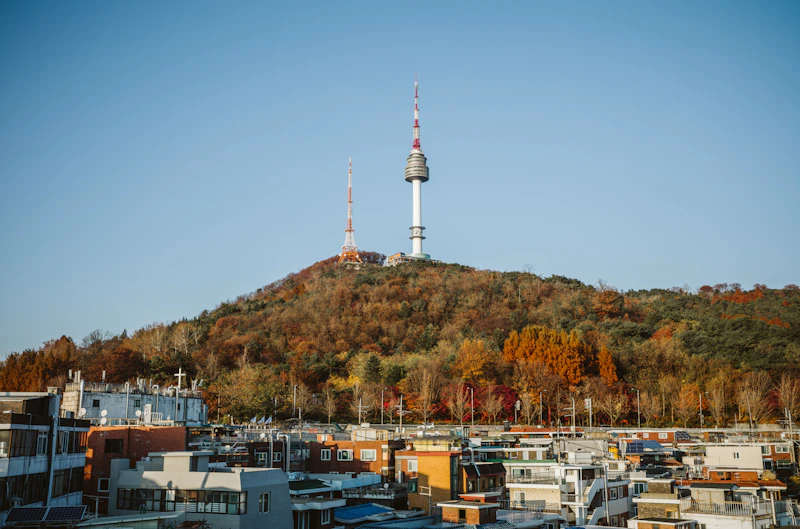
While Namsan Seoul Tower is famous globally, many travelers overlook the expansive Namsan Park encircling the mountain base. The Namsan Dulle-gil (Circular Trail), particularly the North Ring Trail, is designated as a pedestrian-only zone lined with dense foliage. In autumn, maples and ginkgos construct a continuous tunnel of red and yellow over paved, accessible walking paths.
- Location: Hoehyeondong 1(il)-ga, Jung-gu, Seoul
- Nearest Subway: Myeongdong Station (Line 4), Exit 3 or Hoehyeon Station (Line 4), Exit 4
- Admission Fee: ₩0 KRW
- Best Time for Foliage: Late October to mid-November
- Useful Tip: Skip the paid cable car and hike up the gentle wooden boardwalk stairs from Namsan Library. The walk takes roughly 30–40 minutes and offers free, uninterrupted views of the city foliage.
Olympic Park (Songpa-gu)
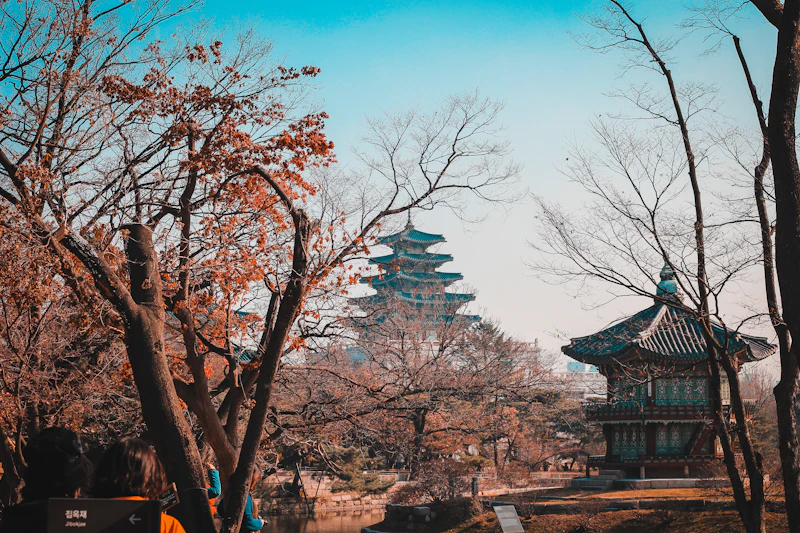
Built for the 1988 Summer Olympics, this massive park in southeastern Seoul features rolling green hills, historic earthen fortress walls (Mongchontoseong), and over 200 modern sculptures. In the fall, the park’s designated foliage walk—featuring hundreds of ginkgo trees flanking the perimeter—turns deep gold. The famous “Alone Tree” (Nollo-no-namu) set against wide open autumn skies is another visual highlight.
- Location: 424 Olympic-ro, Songpa-gu, Seoul
- Nearest Subway: Olympic Park Station (Line 5/9), Exit 3 or Mongchontoseong Station (Line 8), Exit 1
- Admission Fee: ₩0 KRW
- Best Time for Foliage: Late October to early November
2. Historic Palace Grounds & Secret Hanok Walls
Seoul’s Joseon-era historic architecture provides a dramatic backdrop for autumn colors. While entry into the main palace enclosures costs a modest fee (typically ₩1,000 to ₩3,000 KRW), there are multiple ways to experience these heritage sites completely free of charge.
Deoksugung Stonewall Walk (Jeongdong-gil)
The 900-meter stone wall surrounding Deoksugung Palace is widely regarded as one of Korea’s most beautiful pedestrian streets. Framed by mature ginkgo trees and classic Korean masonry, Jeongdong-gil offers a peaceful cultural walk filled with historic buildings, small art galleries, and street performers during autumn afternoons.
- Location: 99 Sejong-daero, Jung-gu, Seoul
- Nearest Subway: City Hall Station (Line 1 or 2), Exit 1 or 12
- Admission Fee: ₩0 KRW for the Stonewall Walk (Palace interior entry is ₩1,000 KRW, or ₩0 KRW if wearing traditional Hanbok)
- Best Time for Foliage: Late October to early November
- Useful Tip: Visit the Jeongdong Observatory, located on the 13th floor of the Seoul Metropolitan Government Seosomun Building. Entry is free, and the view down into the autumn foliage of Deoksugung Palace is unmatched.
Free Palace Entry via Hanbok & Special Days
Seoul’s “Five Grand Palaces”—Gyeongbokgung, Changdeokgung, Deoksugung, Changgyeonggung, and Gyeonghuigung—are epicenter hotspots for fall foliage. You can access these historic palace grounds without paying an entry fee through two primary methods:
- Wearing Traditional Hanbok: Visitors wearing traditional Korean clothing (Hanbok) receive free entry (₩0 KRW) into Gyeongbokgung, Changdeokgung (excluding the Secret Garden), Deoksugung, and Changgyeonggung year-round. While renting a Hanbok costs money, wearing one you own or combining rental packages makes access free.
- Culture Day (Munhwa-ga Ineun Nal): On the last Wednesday of every month, entry to all major palaces and royal tombs across Seoul is completely free (₩0 KRW) for all visitors.
- Gyeonghuigung Palace: Unlike the larger palaces, Gyeonghuigung is completely free of charge (₩0 KRW) every single day for all visitors and offers a quiet, uncrowded courtyard framed by autumn trees.
Bukchon Hanok Village & Samcheong-dong
Nestled between Gyeongbokgung and Changdeokgung palaces, Bukchon Hanok Village is a preserved neighborhood of hundreds of traditional Korean houses (hanok). Walking through these residential alleys offers glimpses of tiled roofs juxtaposed against fiery red maples and yellow ginkgo trees rising from hidden courtyards. Descending from Bukchon into Samcheong-dong reveals main avenues lined with golden ginkgo trees and boutique artisan shops.
- Location: Gyedong-gil & Samcheong-ro, Jongno-gu, Seoul
- Nearest Subway: Anguk Station (Line 3), Exit 1 or 2
- Admission Fee: ₩0 KRW
- Important Etiquette Tip: Bukchon is an active residential zone. Visitors are requested to keep noise to a minimum and observe designated visiting hours (typically 10:00 AM to 5:00 PM for designated residential lanes).
3. Scenic Cultural Walks & Riverside Trails
For visitors who prefer active sightseeing, Seoul offers extensive networks of interconnected urban walking paths, historic city wall hikes, and riverside streams lined with foliage.
Cheonggyecheon Stream
Stretching 11 kilometers through the heart of downtown Seoul, Cheonggyecheon is an urban restoration project that sits below street level. Walking along the stone paths beside the stream offers a quiet retreat from city traffic. In autumn, reeds, wild grasses, and planted foliage along the banks change color, creating a natural ribbon through the glass towers of downtown.
- Location: Starts at Cheonggye Plaza (near Gwanghwamun) and flows east toward the Han River
- Nearest Subway: Gwanghwamun Station (Line 5), Exit 5 or City Hall Station (Line 1/2), Exit 4
- Admission Fee: ₩0 KRW
- Special Autumn Event: In early to mid-November, the annual Seoul Lantern Festival is held along Cheonggyecheon Stream. Hundreds of illuminated paper lanterns float along the water every evening. Viewing the festival is completely free.
Hanyangdoseong: Seoul City Wall Trail (Naksan Mountain Segment)
Originally constructed in 1396 to defend the capital of the Joseon Dynasty, the Seoul City Wall stretches across the ridges of Seoul’s inner mountains. The Naksan Mountain segment is the easiest and most accessible section to hike. Starting from Hyehwa-dong or Dongdaemun, the trail ascends past ancient stone fortifications surrounded by autumn flora, leading up to Naksan Park.
- Location: 50 Naksan-gil, Jongno-gu, Seoul
- Nearest Subway: Hyehwa Station (Line 4), Exit 2 or Dongdaemun Station (Line 1/4), Exit 1
- Admission Fee: ₩0 KRW
- Best Time to Visit: Late afternoon. You can watch the autumn sun set over the city skyline, followed by the illumination of the historic stone wall lights after dark.
Inwangsan Mountain Trail
For a slightly more challenging free outdoor excursion, Inwangsan (338m) provides sweeping views of Gyeongbokgung Palace, the Blue House, and Namsan Tower. The well-maintained wooden boardwalks and granite steps follow the historic city wall. During late October, the exposed granite peaks contrast sharply with the vibrant orange and red mountain forests below.
- Location: Muak-dong, Jongno-gu, Seoul
- Nearest Subway: Gyeongbokgung Station (Line 3), Exit 1 or Independent Gate (Dongn独立門) Station (Line 3), Exit 3
- Admission Fee: ₩0 KRW
- Hike Duration: 1.5 to 2 hours round-trip
4. Autumn Cultural Spaces & Free Museums
If cooler autumn breezes set in, Seoul boasts world-class educational and cultural institutions that offer free general admission alongside stunning outdoor gardens.
National Museum of Korea & Outdoor Mirror Pond
The National Museum of Korea is the flagship museum of Korean history and art. While the indoor galleries showcase over 12,000 artifacts—ranging from prehistoric tools to Joseon dynasty porcelain—the outdoor grounds are equally compelling in autumn. The museum’s extensive outdoor gardens feature traditional pavilions, stone pagodas, and a large central body of water called Geoulmot (Mirror Pond), which reflects the surrounding autumn maples.
- Location: 137 Seobinggo-ro, Yongsan-gu, Seoul
- Nearest Subway: Ichon Station (Line 4 / Gyeongui-Jungang Line), Exit 2 (connected via an underground walkway)
- Admission Fee: ₩0 KRW (Main Permanent Exhibition and outdoor park are completely free; special temporary exhibitions may carry a separate fee)
- Operating Hours: Open daily; Monday, Tuesday, Thursday, Friday, Sunday: 10:00 AM – 6:00 PM; Wednesday and Saturday: 10:00 AM – 9:00 PM
National Folk Museum of Korea
Located on the eastern edge of the Gyeongbokgung Palace grounds, this museum illustrates the historic daily life, tools, and traditions of the Korean people. The outdoor exhibition area features replicas of traditional late 19th-century streetscapes, traditional village totems (Jangseong), and classic agricultural buildings set among mature foliage trees.
- Location: 37 Samcheong-ro, Jongno-gu, Seoul
- Nearest Subway: Anguk Station (Line 3), Exit 1 or Gyeongbokgung Station (Line 3), Exit 5
- Admission Fee: ₩0 KRW
5. Essential Practical Tips for Visiting Seoul in Autumn
To ensure a smooth, cost-effective trip, keep these practical logisitical insights in mind when navigating Seoul during the fall season.
Foliage Timing & Peak Schedule
Autumn foliage in Seoul typically follows a predictable schedule based on northern weather patterns:
- First Colors Begin: Mid-October (starting on northern peaks like Bukhansan Mountain).
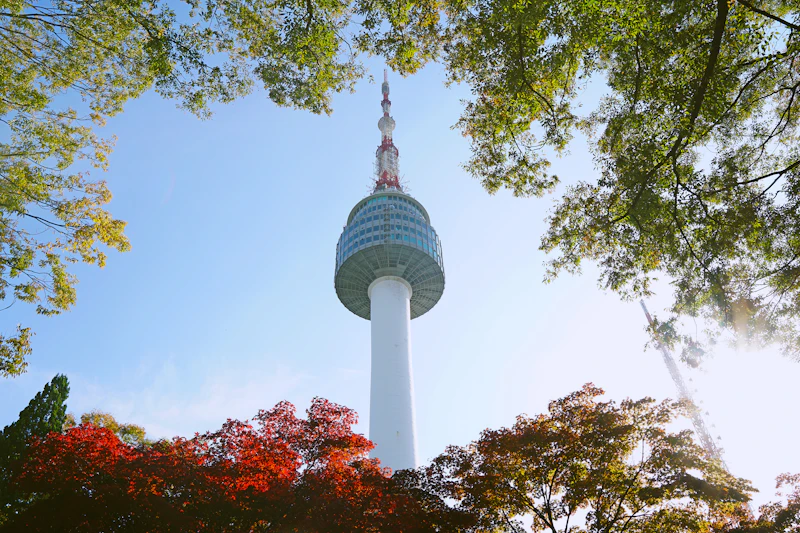
- Peak City Foliage: October 25 to November 10. This is the window when ginkgo trees hit full gold and maple leaves reach vibrant crimson.
- Late Autumn / Leaf Fall: Mid-November onward. Temperatures drop rapidly, and wind events begin clearing leaf canopies.
Weather & What to Wear
Autumn weather in Seoul is generally dry, clear, and sunny, making it ideal for outdoor walking. However, temperatures fluctuate significantly between day and night.
- October Temperatures: Highs around 18°C–22°C (64°F–71°F); lows around 8°C–12°C (46°F–54°F).
- November Temperatures: Highs around 10°C–15°C (50°F–59°F); lows around 1°C–6°C (34°F–43°F).
- Layering Strategy: Pack breathable long-sleeve shirts, a lightweight sweater or fleece, and a medium-weight windproof jacket for evenings. Comfortable, broken-in walking shoes are mandatory, as Seoul involves significant incline walking and stone pavement.
Getting Around for Free or Low Cost
While walking is completely free, Seoul’s public transit network is inexpensive and efficient for transferring between major parks:
- T-Money Card: Purchase a rechargeable T-money card at any convenience store (₩2,500–₩4,000 KRW for the physical card). Base subway and city bus fares start at just ₩1,400 KRW.
- Free Transfer System: Transfers between subways and buses (or between bus routes) are completely free within 30 minutes, provided you tap your T-money card upon exiting every vehicle/gate.
Essential Navigation Apps
International apps like Google Maps have limited walking direction support in South Korea due to national security mapping laws. Download these free, English-supported local apps before arriving:
- Naver Map or KakaoMap: Crucial for accurate turn-by-turn walking directions, real-time bus arrivals, and subway exit guides.
- Subway Korea: An easy-to-use app for looking up optimal subway routes, travel times, and transfer stations.
- Papago: The most accurate translation app for reading Korean signage, menus, and street notices using your phone’s camera.
Summary Budget Breakdown for Autumn Sightseeing
- Park Access (Seoul Forest, Haneul Park, Namsan, Olympic Park): ₩0 KRW
- Cultural Walks (Deoksugung Wall, Bukchon, Cheonggyecheon, City Wall Trails): ₩0 KRW
- Museum Entries (National Museum of Korea, National Folk Museum): ₩0 KRW
- Optional Palace Access (if wearing Hanbok or visiting on Culture Day): ₩0 KRW
- Standard Transport Costs (Daily average via T-Money): ₩4,000 – ₩6,000 KRW per day
By taking advantage of Seoul’s vast public parks, free cultural landmarks, and well-maintained historical walks, you can experience one of Asia’s most spectacular autumn destinations without exceeding your travel budget.
You Might Also Like
- Secret Autumn Foliage Spots in Seoul: Ginkgo Avenues and Maple Walks Away from Crowds
- Ultimate Gyeongju Autumn Foliage Itinerary: Fall Colors at Bulguksa Temple, Cheomseongdae, and Donggung Palace
- Ultimate Gangneung Autumn Weekend Itinerary: Anmok Coffee Street, Scenic Coastal Walks, and Lake Gyeongpo
Frequently Asked Questions
When is the best time to see autumn foliage in Seoul?
The peak season for autumn foliage in Seoul typically runs from mid-October through early November. During these weeks, city parks and historic streets feature brilliant red maples and golden ginkgo trees at their vibrant peak.
Can you visit Seoul’s grand palaces for free?
Yes, admission fees to major palaces like Gyeongbokgung are completely waived if you wear a traditional Hanbok, which can be rented nearby. Additionally, walking along the outer palace walls and surrounding historic streets is always free to the public.
Is it cheap and safe to get around Seoul to reach these free sights?
Seoul is one of the safest cities in the world for travelers, and its public transportation system is exceptionally clean, efficient, and low-cost. Purchasing a reloadable T-money card allows you to easily take subways and buses directly to major parks, trails, and cultural neighborhoods for just a few dollars a day.
Searching Korea Editorial Team
Korea Travel Experts · Based in Seoul
this guide of Korea-based travel writers has been exploring South Korea for over a decade. We visit every destination we write about, verify prices and hours firsthand, and update our guides regularly to ensure accuracy. Our mission is to help travelers experience Korea like a local.